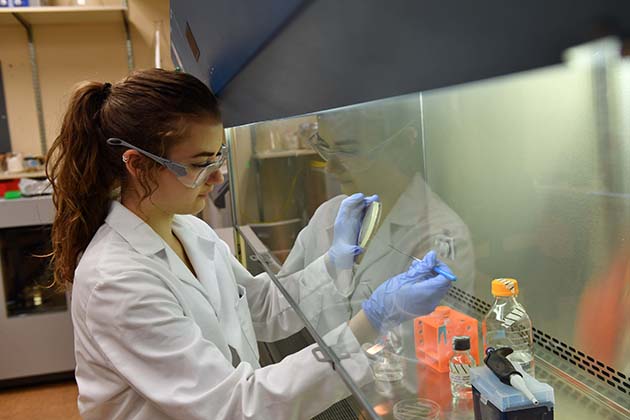
Undergraduate research is a valuable way for students to apply the theoretical concepts they have learned in the classroom to real-world problems, and to gain a deeper understanding of the field of engineering. Whether you are a first-year student just starting to explore the field of engineering or a senior preparing to graduate, you can find undergraduate research opportunities that are right for you.
The faculty in the Voiland School are internationally recognized leaders in emerging areas of science and technology, including surface science, engineering education, catalysis and kinetics, biofilm engineering, sensors, protein engineering, and biomechanics.
Why should I do undergraduate research?
There are several reasons why students should consider participating in undergraduate research in engineering:
- Hands-on experience: Undergraduate research provides students with the opportunity to apply the theoretical concepts they have learned in the classroom to real-world problems.
- Career opportunities: Participating in undergraduate research can help students stand out when applying for jobs or graduate programs.
- Networking: Undergraduate research can provide students with the opportunity to work with and learn from experienced researchers in their field.
- Personal growth: Undergraduate research can help students develop important skills such as problem-solving, critical thinking, and communication.
- Contribution to the field: Undergraduate research can provide students with the opportunity to make a meaningful contribution to the field of engineering.
How do I get started?
If you are considering undergraduate research, now is the time to get involved. It is never too early or too late to get involved.
- Consider the type of research you want to do and the available opportunities. There are a wide variety of topics being investigated in the Voiland School. Pick a topic that interests you. Check out the current list of opportunities; the page is continuously updated:
- Do your homework. After narrowing the list of opportunities down, investigate the faculty member’s webpage and read a few of their published papers. It is ok to not fully understand the paper, but see what type of experiments are completed and if they interest you.
- Reach out to the faculty members. Once you are sure you are interested, send an email to the faculty member, and let them know that you find their research interesting and that you want to get involved.
- Get in the lab! There will typically be several steps to complete before you really start doing research. You will likely need to complete safety training, you may shadow a more senior group member, or be asked to do a small literature review. Each group is different, and the step will be different.
What compensation is available for me?
There are several ways to compensate students for their participation in undergraduate research. Each method has its own advantages and disadvantages, and the choice of compensation will depend on the goals of the research project and the resources available.
- Course credit. This allows students to receive academic credit for the research they are conducting, which can be applied towards their degree requirements. For research projects with a chemical engineering or bioengineering focus, students can complete a 3-credit CHE or BIOENG 499 and substitute a Chemical Engineering or Bioengineering elective. Completing a 499 requires a “product.” This product usually takes the form of a presentation at SURCA.
- Hourly pay. This can provide students with financial compensation for their time and effort spent on the research project.
- Volunteer basis. Some research opportunities may be offered on a volunteer basis, where students do not receive any financial or academic compensation but gain valuable experience and skills. Many groups will have new students start out on a volunteer basis to ensure that the group is a good fit.
- Scholarships. A number of scholarships are available through WSU’s Office of Undergraduate Research. More details are available on the Office of Undergraduate Research Awards page. Note: Most scholarships require the submission of an application in January.
More Information
Still have questions? Email Dr. Saunders.