
- Assistant Professor
Biography
Awards/Honors Received
- 2023 NSF CAREER Award
Lab Vision
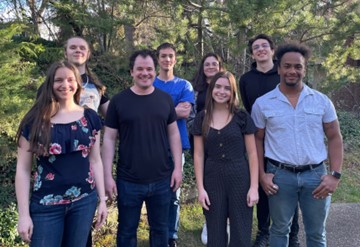
We build computers that run on DNA instead of electricity.
The same circuits that compose your laptops and cellphones can be constructed with liquid DNA reactions, mixed in test tubes, or embedded within soft materials. These liquid circuits can perform tasks such as computing square roots, playing tic-tac-toe, and using machine learning to recognize handwriting.
The inputs and outputs of biochemical computers are molecules that can bind and rearrange physical materials from the nanoscale up. This means that instead of lighting up pixels on a screen, like electronic computers, biochemical computers can directly program biological and non-biological forms of matter to grow, heal, reconfigure, and replicate.
However, most current biochemical computers only contain sufficient energy to power a limited number of computing cycles. This is analogous to an electronic computer that dies after every time you press a single key.
We create DNA reactions that can replenish chemical reactants and thus sustain biochemical computers to run for extended durations. We use these circuits to program dynamic spatial and temporal behaviors into physical materials. With these techniques, our lab is helping to explore new forms of programmable nanomaterials for use in synthetic biology, biosensors, soft robotics, and intelligent therapeutics.